



Similarly sounding labels applied to best practices, which share a common thread, however, differentiate themselves in true practice; but nevertheless, create such confusion because of their similarity. Let’s break down this confusion…
Spoiler alert… all three share this in common – “Standard”.
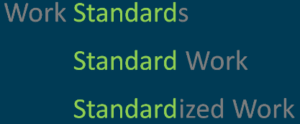
Is it a deal breaker if we get these mixed up or use the wrong one in context (?) – not really as we shouldn’t sweat the small stuff, but for those of us who appreciate clarity and putting things in their proper place, let’s break it down.
Work Standards refers to having a standard, or one best way, to do our work. Standard Work or Lean Standard Work is the best combination of people, process, technology and tools (including machines) to be productive, and Standardized Work is a combination of the first two in addition to training and sustaining – Got it!
Work Standards can take several forms and degrees of detail. The first form of a Work Standard, and least in detail, is a standard operating procedure or SOP. An SOP, for all practical purposes, is more informational than instructional; whereby, the next form of Work Standards picks up – the work instruction or job breakdown sheet. An SOP will provide the overall steps of a process, but a work instruction details every step – explaining what, how, and why. In addition to the work instruction, and sometimes included in it, is the highest level of detail in Work Standards, a job aid – what aids us helps us! A job aid might be a picture, fixture, engineering drawing, etc. which provides that extra aid to help us be successful.

Standard Work or Lean Standard Work leverages Lean Thinking to find the best combination of people, process, technology and tools (including machines) to be productive (eliminating waste) by establishing good routines / habits (Kata) and patterns for work to be performed. Standard Work uses Work Standards as a foundation, particularly the work instructions and job aids. Lean thinking is working smarter, not harder by identifying waste in our processes and reducing / eliminating such. The eight (8) wastes of Lean are Defects, Overproduction, Waiting, Non-utilized People, Transportation, Inventory, Motion, and Excessive Processing. The three elements of Standard Work include: 1) Standard Work Worksheet; 2) Standard Work Combination sheet; and 3) Operator Loading Chart. The Standard Work Worksheet is a visual layout of the work area, providing a standard for setting up a work area and quickly ascertaining if standard work is being followed. The Standard Work Combination sheet shows what process steps are being performed by what operator, determined by assigning enough work elements or tasks to a specific operator that can be completed within Takt Time (the pace at which to produce an outcome to meet the customer demand for a given period of time). The Operator Loading Chart is posted at the cell or work center to identify how many operators should be present and that their individual workload is balanced to Takt Time. The Work Standards work instructions provide the standard workflow for establishing the cycle times and building out the Standard Work Combination sheets and ultimately the Standard Work Worksheets and Operator Loading Chart.

Standardized Work is a combination of Work Standards and Standard Work in addition to training and sustaining. Once Standard Work is created utilizing the Work Standards, training is necessary to teach the team how to follow Standard Work and sustain the outcome. Sustaining the outcome is measured typically in several forms… Safety, Quality, On-time Delivery, Cost, and Innovation and Growth.
Hopefully that clears up the confusion. If not, no worries as you are welcome to visit the IMEC website for an automated presentation explaining this a bit more.
Continue striving to “Work Smarter, Not Harder”, and as always be safe and have fun!